A steadier voice, one word at a time.
Speech Steady plays your voice back through your headphones a split second late. That small echo helps many people who stutter speak more smoothly. A built-in noise filter keeps the echo on your voice, not the room.

Free for 1 hour every week. $4.99 once for unlimited. No account. No data collected.
Available for iPhone.
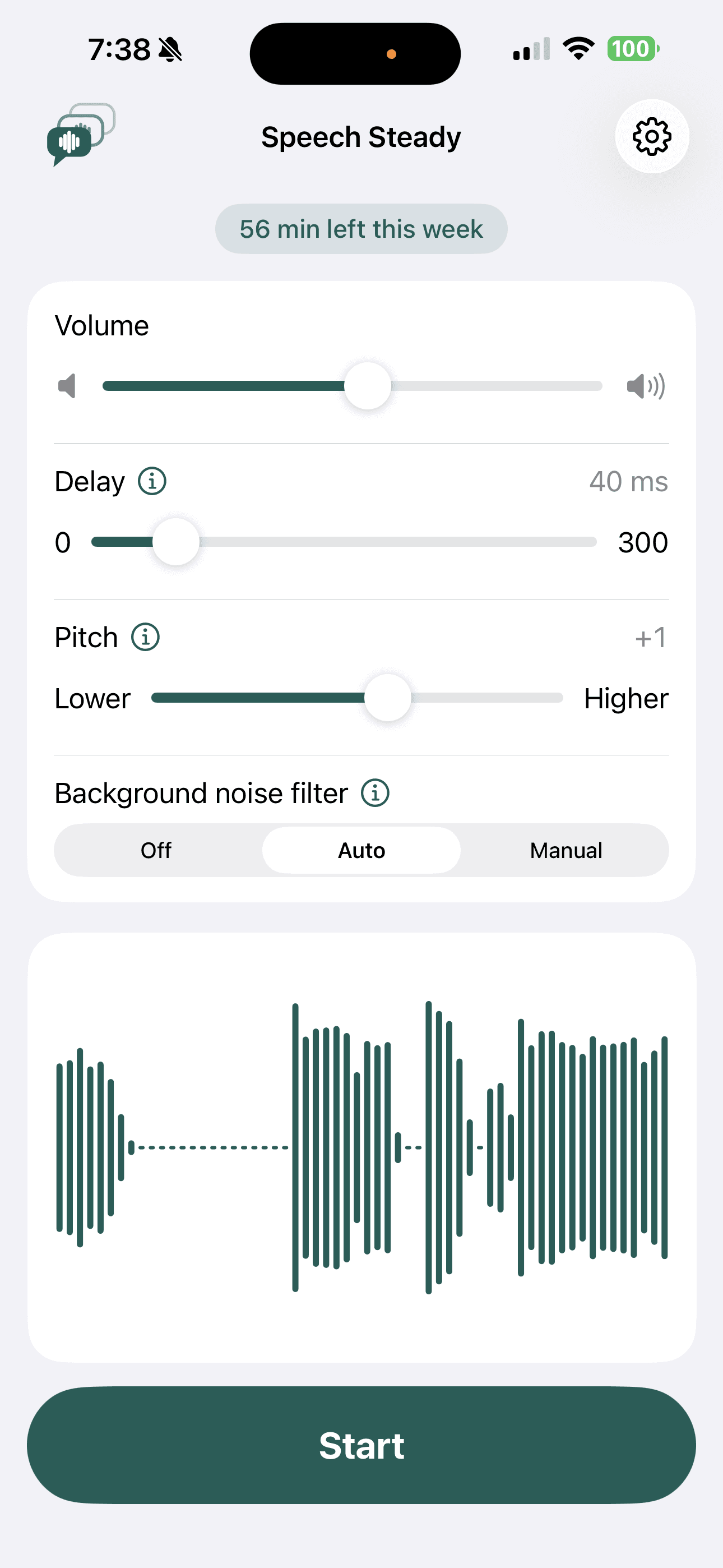
Plug in, pick a delay, and start talking.
- 1
Plug in headphones
Any wired pair works. The app checks them and corrects for their delay.
- 2
Pick your delay
Slide it shorter or longer until your speech feels steadier.
- 3
Start talking
Read aloud, rehearse a call, or just talk. You hear yourself a beat late.
It's like talking along with a slightly late echo of yourself. Your brain eases into a steadier pace to match it.
The technique is called delayed auditory feedback, or DAF. You choose how late the echo arrives, and you can change it any time.
Wired headphones work best. Bluetooth adds its own delay, which the app accounts for where it can.
It hears your voice, not the room.
Most DAF aids echo everything the microphone picks up. The dishwasher, the TV, the next table over, all played back a beat late, right in your ears.
We know because we used them, both hardware devices and apps, before building this one. That echoed noise was the most distracting part. So Speech Steady has a background noise filter that focuses on your voice and holds back the sound around you. The echo you hear is yours.
Use it where you need it
A restaurant counter, a café, an open office, a busy kitchen. Not only a quiet room at home.
Less to tune out
Without the room echoing back at you, your attention stays on your own speech.
Included in the free hour
The filter is part of every plan. Try it somewhere noisy before you pay anything.
Who reaches for it
People who stutter
Many people speak more fluently while using DAF, especially when reading aloud. Use it to practice a presentation, a phone call, or a page of a book.
Parkinson's and fast speech
Speech therapists use DAF to help slow a rushed speaking rate, including in Parkinson's. The controls are large and simple, with nothing small to tap.
Parents helping a child practice
It works best as a practice tool alongside a speech therapist. Nothing about your child is collected, and there is no account to make.
Speech therapists and their clients
Clients can install it and start in the same session, with no sign-up. The delay is adjustable, and the research behind it is linked below.
Small app, carefully built
It does one thing. These are the details that make it feel right in your ears.
Background noise filter
Holds back the clatter and chatter around you, so the echo in your ears is only your voice.
Adjustable delay
Set the echo anywhere from 0 to 300 milliseconds.
Very low latency
Measured and corrected for your headphones automatically.
Works with the screen off
Lock your phone and keep practicing.
No account
Open it and start. No sign-up, no email address.
One price, no subscription
$4.99 once for unlimited use. Or stay on the free hour each week.
DAF isn't new. Researchers have studied it for decades.
Delayed auditory feedback has been studied since the 1950s. In many studies, people who stutter spoke more fluently while hearing their own voice a fraction of a second late, especially when reading aloud.
Speech therapists have also used it to help people with Parkinson's slow a rushed speaking rate. It doesn't work the same for everyone, and researchers still debate how much it helps in everyday conversation. That's why Speech Steady is free to try.
StutteringLab studies since the 1990s found less stuttering under short delays, most clearly when reading aloud. A 2026 meta-analysis of DAF on its own found no significant overall benefit.See 9 studiesHide studies
- 1993
Nine adults who stutter read aloud with delayed and pitch-shifted feedback. Stuttering dropped at both normal and fast speaking rates, so slowing down was not the only reason it helped.
Kalinowski, Armson, Roland-Mieszkowski, Stuart & Gracco. “Effects of alterations in auditory feedback and speech rate on stuttering frequency.” Language and Speech 36(1), 1 to 16. DOI for Kalinowski, Armson, Roland-Mieszkowski, Stuart & Gracco, 1993 (opens in a new tab)
- 1995
Ten people read aloud with a 50 millisecond delay. Stuttering was significantly lower than with normal hearing.
MacLeod, Kalinowski, Stuart & Armson. “Effect of single and combined altered auditory feedback on stuttering frequency at two speech rates.” Journal of Communication Disorders 28, 217 to 228. Repository for MacLeod, Kalinowski, Stuart & Armson, 1995 (opens in a new tab)
- 1996
Compared several short delays at normal and fast speaking rates. The size of the delay mattered, which is why Speech Steady lets you adjust it.
Kalinowski, Stuart, Sark & Armson. “Stuttering amelioration at various auditory feedback delays and speech rates.” European Journal of Disorders of Communication 31(3), 259 to 269. DOI for Kalinowski, Stuart, Sark & Armson, 1996 (opens in a new tab)
- 2003
Followed people using DAF on their own, outside the clinic, and looked at how it worked for them as a practice tool in daily life.
Van Borsel, Reunes & Van den Bergh. “Delayed auditory feedback in the treatment of stuttering: clients as consumers.” International Journal of Language and Communication Disorders 38(2), 119 to 129. DOI for Van Borsel, Reunes & Van den Bergh, 2003 (opens in a new tab)
- 2006
Found plenty of lab evidence that altered feedback changes stuttering, but less is known about everyday conversation and who benefits most.
Lincoln, Packman & Onslow. “Altered auditory feedback and the treatment of stuttering: a review.” Journal of Fluency Disorders 31, 71 to 89. Repository for Lincoln, Packman & Onslow, 2006 (opens in a new tab)
- 2017
Fifteen adults who stutter and fifteen who don't spoke with a 100 millisecond delay. Spontaneous speech got more fluent for the people who stutter, while the delay made fluent speakers less fluent.
Furini, Picoloto, Marconato, Bohnen, Cardoso & Oliveira. “The role of auditory temporal cues in the fluency of stuttering adults.” Revista CEFAC 19(5), 611 to 619. DOI for Furini, Picoloto, Marconato, Bohnen, Cardoso & Oliveira, 2017 (opens in a new tab)
- 2018
Thirty people aged 8 to 46 tried DAF. It immediately reduced word repetitions and slowed their speaking rate.
Buzzeti & de Oliveira. “Immediate effect of delayed auditory feedback on stuttering-like disfluencies.” Revista CEFAC 20(3), 281 to 290. DOI for Buzzeti & de Oliveira, 2018 (opens in a new tab)
- 2019
Reviewed 16 studies. Altered feedback generally reduced stuttering, most clearly when reading aloud, with results that varied by person and severity.
Romeiser, Kiley & Nocella. “The effects of altered auditory feedback (AAF) on fluency in adults who stutter: a systematic review.” University of Vermont, Communication Sciences and Disorders. Repository for Romeiser, Kiley & Nocella, 2019 (opens in a new tab)
- 2026
Pooled five studies (61 people) that tested DAF on its own and found no significant overall benefit compared with normal hearing. The authors urge caution and more research.
Iimura, Yamamoto & Ishida. “Immediate effects of delayed auditory feedback on stuttering: a systematic review and meta-analysis of literature published 2000 to 2024.” International Journal of Language and Communication Disorders. DOI for Iimura, Yamamoto & Ishida, 2026 (opens in a new tab)
Parkinson's and fast speechClinical reports and small studies found DAF slowed a rushed speaking rate for many participants. Effects on clarity vary from person to person.See 3 studiesHide studies
- 1981
An early clinical report that DAF helped some people with Parkinson's whose speech was too fast to follow.
Downie, Low & Lindsay. “Speech disorder in parkinsonism: usefulness of delayed auditory feedback in selected cases.” Journal of Neurology, Neurosurgery and Psychiatry 44(9). Publisher for Downie, Low & Lindsay, 1981 (opens in a new tab)
- 2002
Three men with Parkinson's improved in speech rate, intelligibility, and fluency with DAF, especially with a clinician coaching them.
Blanchet. “Factors influencing the efficacy of delayed auditory feedback in treating dysarthria associated with Parkinson's disease.” Doctoral dissertation, Louisiana State University. Repository for Blanchet, 2002 (opens in a new tab)
- 2004
Sixteen people with Parkinson's. Delayed feedback clearly slowed their speaking rate. Group results on clarity were mixed, but some individuals benefited.
Brendel, Lowit & Howell. “The effects of delayed and frequency shifted feedback on speakers with Parkinson's disease.” Journal of Medical Speech-Language Pathology 12(4), 131 to 138. PMC for Brendel, Lowit & Howell, 2004 (opens in a new tab)
Other uses
Some people also use DAF to practice slowing a fast speaking rate, for example with cluttering. Published evidence here is thin, so we don't cite it.
Results vary from person to person, and recent reviews call for more research. We summarize each study in plain words and link to the original so you can judge for yourself.
Your voice never leaves your phone.
Nothing recorded
Your voice is delayed in memory for a fraction of a second, then gone.
Nothing uploaded
Audio is processed on your iPhone. It is never sent to us or anyone else.
No account, no tracking
No sign-up, no ads, no analytics. We don't know who you are.

Free every week. Pay once if you want more.
Free
1 hourevery week
- No payment, no trial to cancel
- Resets automatically each week
- Every feature included, noise filter too
Unlimited
$4.99once
- Practice as long as you like
- Yours forever, restore it on a new iPhone
- No subscription, ever
Purchases are handled by Apple. We never see your payment details.
Questions people ask
Does this cure stuttering?
No. Speech Steady is a practice tool, not a treatment. Many people speak more fluently while using delayed auditory feedback, especially when reading aloud, but results vary from person to person and the effect is usually strongest while the app is on. Try it free and see how it works for you.
Can my child use it?
Yes, with a parent or speech therapist nearby. The app collects nothing about anyone, so there is no account to make and no record of your child. Keep the volume low and comfortable, and stop if the delay feels confusing or upsetting. A speech-language pathologist can tell you whether DAF suits your child.
Do I need special headphones?
No. Any wired headphones or earbuds work, including Apple's Lightning or USB-C EarPods. Wired is best because the sound reaches your ears with almost no extra delay.
Does Bluetooth work?
It works, but Bluetooth adds its own delay on top of the one you choose, sometimes a lot. Speech Steady measures your headphones and corrects for that where it can. If the echo feels too late even at the lowest setting, try a wired pair.
What delay should I start with?
Many of the studies we link to used short delays, roughly 50 to 100 milliseconds. Start near the low end, read a paragraph aloud, then nudge it up or down until your speech feels steadier. Your speech therapist may suggest a specific setting.
Any tips for getting started?
Some people find it helps to make a short starter sound, like a soft "ah," just before they speak. That gets the delayed echo going in your ears, so your first word comes out with the feedback already running. Try it while reading aloud first, then in conversation.
Can I use it outside the house?
Yes. It doesn't have to be practice at home. People have found it helpful to use Speech Steady quietly while ordering at a restaurant or speaking up in public. Earbuds are easy to miss, and the app keeps working with your screen locked. Keep the volume low so you can still hear what's around you.
Does it work in noisy places?
Yes, and this is where Speech Steady differs most from other DAF aids. Many of them echo every sound the microphone hears, so a busy café comes back at you a beat late along with your voice. Speech Steady's background noise filter focuses on your voice and holds back the room, so the echo stays yours and is easier to follow.
Can my speech therapist use it with me?
Yes. There is no account and nothing to set up, so you can open it in a session and start right away. Therapists can adjust the delay to match the exercise, and nothing about the client is ever saved or shared.
Do you record what I say?
No. Your voice goes from the microphone to your headphones a fraction of a second later and is then gone. It is never saved, uploaded, or listened to by anyone. The only things the app remembers are your settings and how many free minutes you have used this week, and those stay on your iPhone.
Is there an Android version?
Not right now. Speech Steady is for iPhone only.
How do I restore my purchase?
If you bought the $4.99 unlock and got a new phone or reinstalled the app, open Speech Steady and tap Restore Purchase. Make sure you are signed in with the same Apple Account you used to buy it.
How do I get help?
Email support@speechsteady.com. A real person reads every message and replies, usually within a couple of days.
Give it a week. It's free.
For iPhone. No account needed.